
Site Super Admin • November 4, 2025
Week 9 NFL Injury Recap & Fantasy Impact
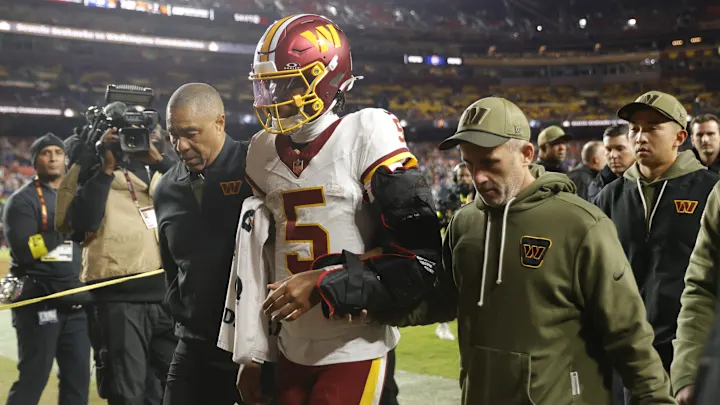
Week 9 around the NFL delivered another wave of fantasy-shifting injuries, highlighted by a gruesome elbow dislocation suffered by Jayden Daniels and several key skill-position players now trending toward missed time. From non-throwing-arm ligament damage to multiple high ankle sprains, clavicle fractures, rib trauma,

Week 9 around the NFL delivered another wave of fantasy-shifting injuries, highlighted by a gruesome elbow dislocation suffered by Jayden Daniels and several key skill-position players now trending toward missed time. From non-throwing-arm ligament damage to multiple high ankle sprains, clavicle fractures, rib trauma, and new concussions entering the protocol, fantasy managers are once again forced to scramble as playoff pushes tighten. Below, we break down timelines, return-to-play expectations, and how each injury should influence your weekly fantasy decisions.
Quarterbacks
Jayden Daniels
Injury: Left elbow dislocation
Analysis: Daniels suffered a gruesome elbow dislocation on Sunday night and is going to miss significant time. Miraculously, no fracture occurred, but no doubt there is significant ligament damage. Some of the most common ligaments that can be damaged are the Ulnar Collateral Ligament (UCL), Lateral Collateral Ligament (LCL), and the Annular Ligament, as well as the joint capsule. It remains to be seen which of these ligaments are damaged and if they will require surgery, either now or during the offseason.

The good news is that Daniels is a right-handed passer. If this injury were to his right elbow, the prognosis would be season-ending for sure, but, being his non-throwing arm, there is a chance he can return later this season. The timeline is tricky; we recently saw Khalil Mack return from an elbow dislocation in just four weeks. Mack, as a defensive end, arguably needs his elbow more stable than a quarterback's non-throwing arm. Most cases will take longer than four weeks, but it is again extremely dependent on the level of tissue damage.
Fantasy managers also need to consider that Washington is trending poorly this season, even if Daniels "could" return in 5-6 weeks, will they want him to if they are say, 5-9? In short, fantasy managers need to make plans to be without Daniels for the majority of the remaining fantasy season, and if you need the roster space, cut him.
CJ Stroud
Injury: Concussion
Analysis: Stroud's head bounced off the turf while attempting to slide, and a concussion knocked him out for the rest of the day. CJ will have to pass through the NFL's concussion protocol before returning to play.
Running Backs

Aaron Jones
Injury: AC joint sprain
Analysis: Jones has what is being dubbed a minor AC joint sprain. The AC joint is commonly injured when a player lands on the side of his shoulder, and when injured, raising the arm to make a catch and taking on impact is painful. Jones' injury is not expected to sideline him for long, though historically running backs average missing 2.5 games, and almost all of them do miss at least one game. Additionally, backs average a 19% dip in fantasy points in the first game after an AC joint.

Ollie Gordon
Injury: High ankle sprain
Analysis: Gordon suffered a classic high ankle sprain, getting rolled up on from the outside as he was attempting to run block. He missed the rest of the game but is considered day-to-day, which hints at a grade I injury with no true laxity or instability in the ankle. If true, this makes it possible for him to play in week 10. A grade II or III high ankle sprain with associated instability can impact the ability to quickly cut and powerfully change direction; however, a grade I injury will not, and historically, running backs average no drop off in fantasy points after a high ankle sprain.
Samaje Perine
Injury: High Ankle Sprain
Analysis: Perine also suffered a high ankle sprain, but it is believed to be more severe compared to Gordon's. The Bengals have a bye in the upcoming week, but Perine is in jeopardy of missing week 11 as well. A multi-week designation leads us to believe this is a grade II injury with true ankle instability present. Rehab will be focused on regaining stability to allow him to quickly and confidently plant and cut off the injured ankle. At 30 years old, healing is slower than it has ever been for Perine. Expect him to miss at least a few games.
Wide Receivers

Puka Nacua
Injury: Rib injury
Analysis: Fresh off an ankle injury, Nacua was enjoying yet another amazing game until he was tackled onto the ball, causing a chest injury. Chest injuries, which are often rib or sternum injuries, are more than just a pain tolerance issue. Knowing that Nacua's injury is to the anterior portion of his rib cage, we know that the pec muscles and oblique muscles attach to the region that is injured. These muscles are critical for twisting to catch the ball, blocking, and securing the ball while running. Nacua's injury is not considered severe, and a week's rest should be long enough for the function of these muscles to be restored. Receivers average missing less than one game with a chest/rib injury, but do average a 17% decline in fantasy points.

Brian Thomas Jr.
Injury: Ankle injury
Analysis: Brian Thomas Jr. made a nice run after the catch late in regulation, only to have a defender land on the outside/rear of his foot while it was planted, causing a significant eversion moment at the ankle and a high ankle sprain. The foot was planted and actually rotates outwards quite a bit, putting a great deal of stress through the syndesmotic ligament that holds the tibia and fibula together. To date, Jacksonville has not provided much information on the severity of Thomas Jr's injury, but I would not be surprised if the struggling second-year receiver misses a few games.
Receivers average missing 2.8 games with a high ankle sprain, but surprisingly see no drop off in fantasy points when they return from injury.
Luke McCaffrey
Injury: Clavicle fracture
Analysis: McCaffrey fractured his clavicle on the opening kickoff. The average return to play following a clavicle fracture is 9-10 weeks, likely ending his season.
Matthew Golden
Injury: Shoulder injury
Analysis: Golden left Sunday's game with a shoulder injury but is considered "day-to-day". In order to play, he will need to have a full range of motion and enough strength to make overhead catches. With a mild shoulder injury, this can usually be achieved in a few days. Golden's game is built on speed, getting down the field, and running after catch rather than contested catches, which bodes well for his prognosis with this type of injury. Receivers average just a 7% dip in fantasy points in the first game after a shoulder injury.
Dyami Brown
Injury: Concussion
Analysis: Brown suffered a concussion on Sunday and will have to pass through the NFL's concussion protocol prior to playing.
Kayshon Boutte
Injury: Hamstring strain
Analysis: Boutte publicly disclosed that he has a grade I hamstring injury. With a grade I injury, there is minimal true tissue damage and hardly any loss of range of motion, strength, or power. When pain subsides, production returns to normal, though re-injury risk will be heightened.
Receivers average missing 1.9 games; if Boutte's statement is true, he will likely miss one game max.
Tight Ends

Tucker Kraft
Injury: ACL tear
Analysis: Kraft unfortunately tore his ACL (possibly MCL as well) after a friendly fire shot to his lateral knee while pulling to block. Kraft's season is over, but his career is still very much on the rise.
The ability to return from an ACL injury and play well depends on numerous factors. Age (25) is working in Kraft's favor to help with a quick, smooth recovery. The number of tissues is yet to be disclosed, but watching the video, it's hard to imagine this is an isolated ACL tear, and the potential need for multiple tissues to be repaired can slow down rehab. The time from surgery (not injury) to week one makes a massive difference. Players usually need to wait several weeks to undergo surgery, meaning Kraft will likely have just about 9 months from the time of surgery until week one. This would make it very difficult to be ready to go right away. Lastly, athletic ability at baseline, which we can all agree is very much in Kraft's favor, should help with a great recovery.

All this together, Kraft has age and athleticism in his favor, time and number of tissues (assumed) not in his favor, and it will be a true toss-up if he can be ready week one next season. If not week one, at some point, he certainly will be ready and should resume a prolific career. Tight ends are less affected by an ACL compared to running backs and receivers, and we have seen examples like Zach Ertz and TJ Hockenson return to play at high levels.
Travis Kelce
Injury: Rib injury
Analysis: Kelce got crunched in the ribs just before halftime but finished out the game. He appears to have avoided anything major, but don't be surprised if he misses some practices this week. Rib injuries are much more than a pain tolerance issue and can be tricky for a tight end. Several key muscles involved in blocking attach on the ribs, including the pecs, lats, and obliques, and when a rib injury is present, these muscles can be affected. The same muscles are also critical for rotating the torso and maneuvering the arms to make catches.
The good news is that tight ends average missing less than one game due to a rib injury and see no drop off in fantasy points.
Cole Kmet
Injury: Concussion
Analysis: Kmet suffered a concussion. He will have to progress through the NFL's concussion protocol before playing.